
The sources of capital used to fund large-scale real estate development can take many forms, but will commonly be sourced from both debt and equity investors. These two categories can be further divided into senior or mezzanine debt, and preferred or common equity. Though a development may not always use mezzanine debt or preferred equity, understanding the differences between the various types of capital will help you properly assess the risk/reward trade-off of investment opportunities in this asset class, and allow you to better assess if an investment is appropriate for you.
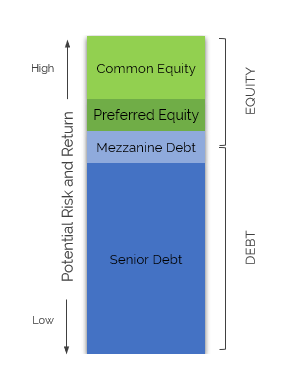
If you are considering a common equity investment in a real estate development, you would receive either a direct or indirect ownership interest in the project, and uncapped participation in the profits of a project if it performs well. Common equity investors are the primary beneficiaries of profits generated and seek capital appreciation of their investment, rather than debt investors who are entitled to fixed interest payments with no participation in project profits.
Control of the development and major decisions are made by common equity investors—typically by the general partner on behalf of the limited partner investors. Compared to other sources of funds in the capital stack, common equity investors bear more risk as they are the first money in and the last money out. However, with average annualized returns that can range from 16%-20% or greater, common equity also has the highest potential returns of any layer in the capital stack.
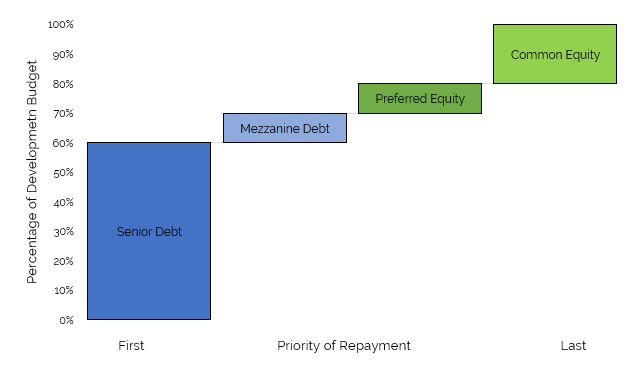
Similar to mezzanine debt, preferred equity investors receive a regular interest payment. However, in some cases preferred equity investors may have limited participation in the profits generated. Preferred equity investors are repaid after debt holders (senior or mezzanine) though will have priority over common equity investors. The risk and return expectations for preferred equity holders is generally higher than mezzanine debt, but less than common equity.
Investors in mezzanine debt receive a prescribed rate of return, but do not have any participation in the profits of a development. Unlike senior debt holders, investors in mezzanine debt will not have a first mortgage to secure their loan. However, they may have a lien granted against the property or be assigned a partnership (equity) interest in the case of default, effectively making mezzanine debt a convertible debt-equity position. Mezzanine debt is more common in multifamily developments and is not generally part of the capital stack for condominium or low-rise developments.
When employed, mezzanine debt may comprise 5%-25% of the capital stack and is typically sourced from large institutional investors or private lenders. Returns for mezzanine debt are higher than senior debt and reflect the increased risk of the unsecured convertible loan.
In a development, holders of senior debt (a construction loan or permanent mortgage) are considered the most protected, as the property is held as collateral to secure the loan. As the largest layer of the capital stack—typically 50%-70% of total development costs—senior debt is the first layer to be paid back and sits in priority to all other sources of capital. Senior debt is usually exclusively provided by commercial banks, pension funds, or large institutional investors willing to accept a low rate of return in exchange for bearing the lowest amount of risk. Returns for senior debt investors will generally be significantly lower than equity returns and will range from the low- to-mid single digits annually for high-quality projects with reputable developers.
Private investments in residential real estate development can offer attractive returns for investors, however, it’s important to understand the benefits and risks of the various layers of capital within a development to ensure that it fits within your risk tolerance and investment goals.
Greybrook exclusively participates as a common equity partner and works with best-in-class developers to help produce long-term capital appreciation for our investors. While equity investments in large-scale residential real estate development have historically been controlled by high net-worth and institutional investors, our platform allows qualified individuals to access these investment opportunities directly.
Contact us to learn more or to speak with one of our investment representatives.

Greybrook Securities CEO Sasha Cucuz recently joined fellow industry leaders to tackle the economic pressures shaping the future of Canadian housing. Speaking at the Veritas 14th Annual Great Canadian Real Estate Conference, Cucuz participated in a highly anticipated panel discussion…

Listen to this article: It is difficult to find a market conversation today that does not eventually lead back to interest rates. For Canadian advisors, there are particularly good reasons to be paying attention. U.S. Treasury yields have moved materially…

Last season, Greybrook became the first-ever lead sponsor of York Lions Men’s Hockey. This year, extending that support to the women’s program was a natural next step and reflects something we believe deeply: sport shapes future leaders. It is an…

Greybrook team members rode in support of the 7th Annual Velo Blu Charity Bike Ride in Niagara-on-the-Lake, helping raise $270,000 to advance research into rare childhood diseases and gene therapy through the Blu Genes Foundation. Held at the scenic Peller…

On Sunday, September 20, Greybrook joined runners, walkers, volunteers and community supporters at the 17th Annual Constantine Yorkville Run, coming together to raise funds for charities making a difference across Toronto. As a Presenting Partner, Greybrook was proud to once…

Members of Greybrook’s Institutional Capital Markets team recently attended and sponsored Future Proof Festival, the world’s largest four-day wealth management festival, held in Huntington Beach, California. As part of its sponsorship, Greybrook supported the QWealth Canadian Lounge, a dedicated gathering…

Lindsay Heights, our low-rise, master-planned community in the City of Kawartha Lakes, is set to welcome one of its most anticipated neighbourhood retail additions with the opening of a Walmart Supercentre. Located at the northwest corner of Lindsay, at Highway…

This advancement marks a significant milestone for Florida’s first supertall Downtown Miami residence, a signature hallmark of the renowned Waldorf Astoria brand, offering a collection of 205 luxury hotel guestrooms, dedicated five-star service and once-in-a-lifetime experiences. Construction of the staggered…

Listen to this article: The best time to buy durable assets is rarely the moment they feel comfortable to buy. In multifamily, rent growth tells you where a market is today, but the conditions that signal where it is heading…

Dallas-Fort Worth has been one of the most closely watched multifamily markets in the United States over the past several years. Long-term population and employment growth, rapid corporate relocations, relative affordability and a deep, diversified economy have helped draw a…